

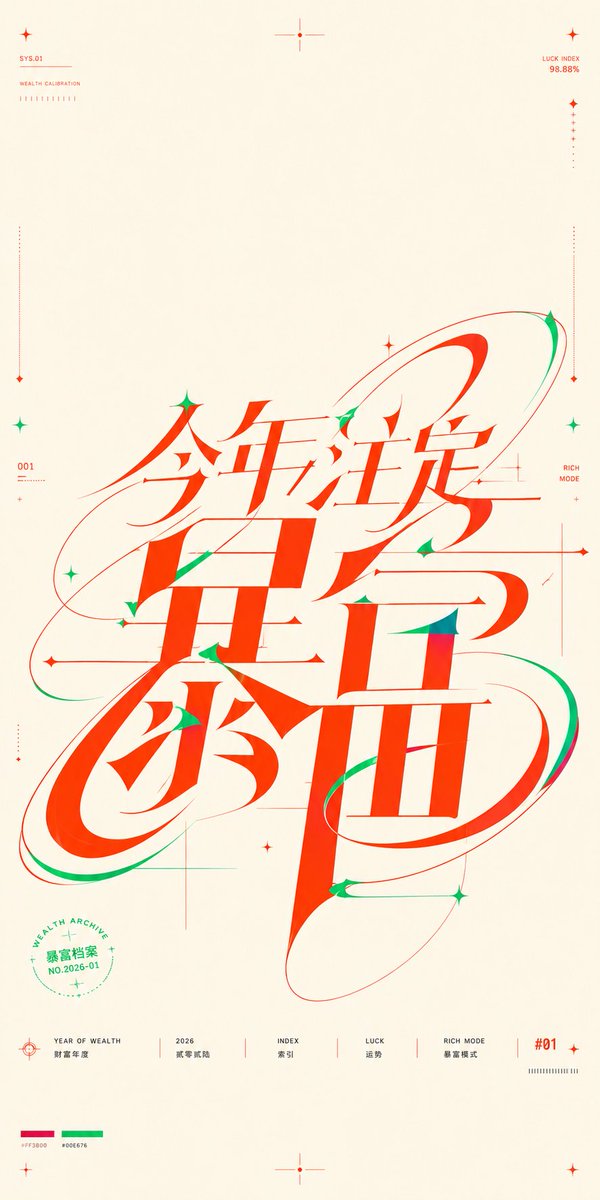
Goal: Create a near-square vertical typographic poster about [theme text], where the core message is not a normal headline but a huge custom continuous Chinese wordmark occupying the middle and lower center of the composition. The lettering should compress the phrase into one shared skeleton so the strokes feel simultaneously readable characters, motion trails, orbital paths, and precision graphic construction.

Canvas: Portrait poster, approximately 9:16 but close to a square-poster feel, warm ivory paper background with generous empty margins. Use a clean editorial graphic-design layout with thin technical guide marks and lots of negative space.

Main wordmark: Place one massive red-orange Chinese calligraphic-mechanical logotype in the center, spanning most of the height from just below center to the lower third. Use extremely high contrast strokes: thick vertical slabs, sharp triangular cuts, thin hairline crossbars, soft elongated curves, and oval loop structures. The main visible phrase should read [theme text]. Make the characters interlock and overlap as a single custom glyph, with sweeping red and green orbital ribbons wrapping around it. Add small green shadow strokes and accents inside cuts and terminals, especially on curves and pointed joints. The overall feeling should be lucky, wealthy, futuristic, energetic, and precise.

Color palette: Use exactly 3 dominant colors: warm ivory background, vivid fortune red-orange for the main typography and most linework, and emerald green for secondary accents. Include tiny printed palette swatches near the bottom left labeled with hex-like values, red [red color code] and green [green color code].

Decorative and technical elements: Include 12 small star/cross markers distributed around the poster: 1 at the upper left, 1 at the top center, 1 at the upper right, 2 along the left side, 2 along the right side, 3 around the central wordmark, 1 at the bottom center, and 1 at the lower right. Include 4 long thin dotted vertical calibration lines near the left and right margins, each ending with tiny diamond markers. Include several ultra-thin horizontal and vertical construction lines crossing behind the wordmark, like a design grid, but keep them subtle and airy. Add 3 large elliptical orbital paths around the wordmark: one sweeping from left middle to upper right, one wrapping the lower left loop, and one long tilted oval around the lower right character.

Top micro text: At the upper left, small red technical labels read “SYS.01” and “WEALTH CALIBRATION” with a short row of tiny tick marks below. At the upper right, small red text reads “LUCK INDEX” and “98.88%” with a vertical dotted measure line below. Keep these labels tiny and precise.

Side micro text: On the left side near the middle, add “001” with miniature unreadable calibration ticks beneath. On the right side near the middle, add “RICH MODE” in small red text, aligned near a fine vertical guide.

Circular seal: In the lower left quadrant, place a small green circular seal partly under the main typography. It contains the curved English text “WEALTH ARCHIVE”, the Chinese text [seal text], and “NO.2026-01”, plus tiny stars and dotted ring marks.

Bottom information row: Along the bottom, create exactly 6 separated footer items with thin red dividers: 1) a target/crosshair icon with “YEAR OF WEALTH” and Chinese text “财富年度”; 2) “2026” with Chinese text “财富新船”; 3) “INDEX” with Chinese text “索引”; 4) “LUCK” with Chinese text “运势”; 5) “RICH MODE” with Chinese text “暴富模式”; 6) a red “#01” label with a small tick barcode beneath. Keep all footer text small, crisp, and aligned on a baseline.

Style constraints: High-end Chinese experimental typography poster, vector-sharp, no photography, no gradients except very subtle paper warmth, no shadows, no realistic objects. Keep the main wordmark legible enough to read while prioritizing sculptural custom lettering, extreme stroke contrast, smooth motion trails, and sparse technical-poster precision.



0 Comments
👥 Co-learning Circle 0
Observe other members' variables & configurations, and click "Study & Retry" to instantly import settings and practice!